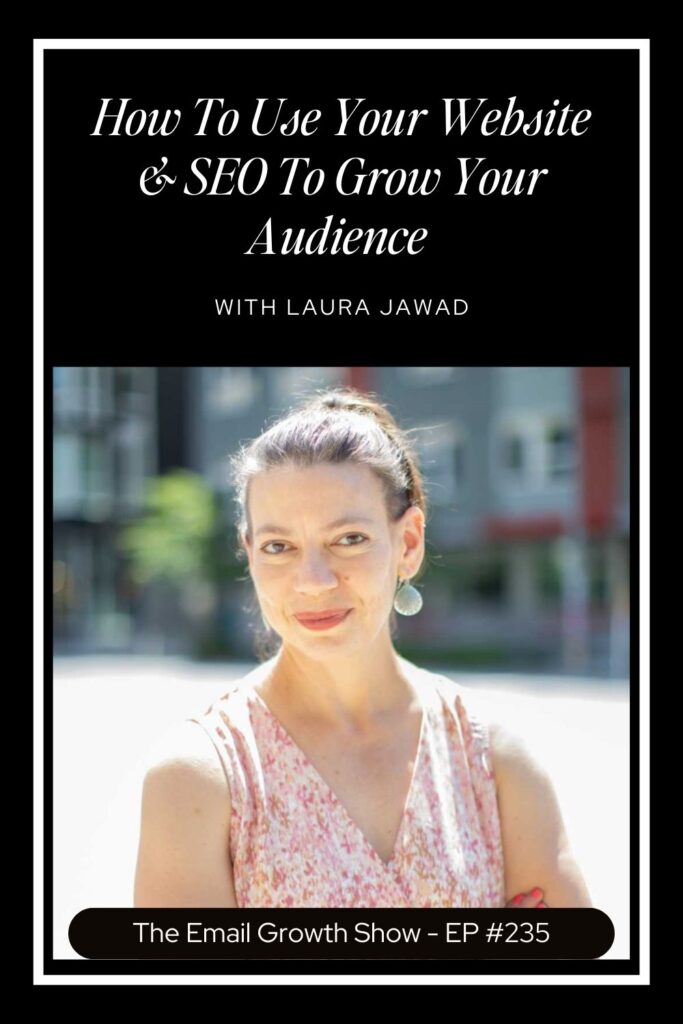
Feat. Laura Jawad
THE EMAIL GROWTH SHOW EPISODE 235
Let’s be honest for a second…
If Instagram disappeared tomorrow, would your business still grow?
Or would everything grind to a screeching halt while you panic-refresh your analytics and whisper, “please don’t let this be how it ends…” 😬
This is exactly why I wanted to bring Laura Jawad onto the podcast.
Because SEO?
It’s the most underrated, misunderstood, and quietly powerful list-building strategy out there – especially if you’re building a business without social media.
And no… this isn’t about becoming a keyword goblin or writing robotic blog posts that suck the soul out of your brand.
This is about turning your website into a trust-building, list-growing machine that works while you’re off doing literally anything else.
Listen to this episode here:
** Read time: 4 – 5 mins | Listen time: 24 mins **
CLICK HERE TO READ THE FULL TRANSCRIPT
[00:00:00] Laura Jawad: If you haven’t optimized your website, you’re gonna be getting traffic for something. It’s just not gonna be what you want. And so if you’re just getting started with this, that’s a really good place to start. Go see what words are driving traffic to your website?
[00:00:12] Which pages are attracting that traffic? And if it’s not what you want it to look like, then you start to build a strategy to steer that ship. And to optimize your website to rank for the words you want to rank for and to drive traffic to the pages you want to drive traffic to.
[00:00:27] Are you a female business owner frustrated with battling the algorithm and looking for growth strategies that don’t involve awkwardly pointing or dancing online or throwing cash at paid ads? Welcome to the email growth show. I’m your host, Kylie Kelly, visibility and email marketing strategist. I grew my email list from zero to almost 10,000 subscribers in less than two years, and the same is possible for YouTube.
[00:00:54] Are you ready to build your email list and start making more money in your online business? Let’s head into today’s [00:01:00] episode.
[00:01:03] Kylie Kelly: Laura, welcome to the email growth Show. I’m so excited to have you on the podcast today.
[00:01:07] Laura Jawad: Thank you so much for having me, Kylie. I am so happy to be here today.
[00:01:10] Kylie Kelly: Now we have some juicy stuff to talk about when it comes to SEO and building your email list using your website, which I’m so excited about. But in case there’s any listeners that don’t know who you are, can you just tell us a little bit about what you do and how you help people?
[00:01:24] Laura Jawad: Yeah, absolutely. So I am an SEO specialist and I support female service providers, coaches, and course consultants who want to grow their audience and fill their client rosters without relying on the socials.
[00:01:38] Kylie Kelly: I love that. And you know me like you’re speaking my language when you say without the socials because I am not a fan of social media, so I love this. in your time working with other business owners. I’d love to just know, for a little bit of inspiration for our listeners. what is it like before someone’s using SEO strategically to after?
[00:01:56] Like Have you seen some really big transformations?
[00:01:58] Laura Jawad: Yeah, absolutely. [00:02:00] And it can really be the difference between, Flipping a light switch and it depends on the use case, obviously, but I’ve had clients who were literally getting zero traffic from Google because. They had settings on their websites enabled that blocked Google from seeing their websites. And then there’s the case where people are getting traffic, but it’s just the wrong traffic because they never optimized. And so then all of a sudden the right traffic starts coming in and that traffic turns into inquiries and bookings and subscribers. So it can really make a pretty profound difference.
[00:02:35] Both in the quality of traffic coming through and then the conversions that you get from that traffic.
[00:02:41] Kylie Kelly: I love that it almost is like turning on a tap by the sounds imagine for anyone listening and even myself, I’m just imagining what it’s like then when. You’re doing the things that you are already doing for me, podcasting, collaborations, things where I am actively participating in stuff. But then imagine turning on a tap and having traffic find [00:03:00] you without doing anything else.
[00:03:02] Laura Jawad: Are you familiar with the ideas of pull and push marketing?
[00:03:05] So push marketing is. Where you create content that you are trying to put out in front of other people advertising social media to some extent, right? You’re trying to push stuff into the algorithms. What’s shown to people pull marketing is when you create content that is, is set up to be found by people who are searching for those solutions.
[00:03:28] So really it’s a fundamentally different way of. Setting up your marketing. I think everyone can benefit from both. But if you haven’t, set yourself up for this pull marketing before, you really are just getting like double duty out of the work that you’re already doing, right? Like you’re already creating your podcast.
[00:03:46] If you were to SEO optimize your show notes, put them on your website, then all of a sudden you’re gonna get traffic from the amount of work that it takes to do that little bit extra is minuscule compared to the work it takes to produce the podcast, if that makes sense. So you’re just getting so much [00:04:00] more ROI on the work that you’re already doing.
[00:04:02] Kylie Kelly: Yeah, absolutely. I know it would be different for every business owner that you’ve worked with, but like I’ve always thought that SEO takes like years or it’s like Pinterest. It’s a long-term strategy. Can you still see results pretty quickly though?
[00:04:12] Laura Jawad: It depends on whether or not you’re starting from scratch or if you have a website that’s already well established. It depends if you have a robust online brand versus someone who is relatively unknown. It depends how competitive your niche is.
[00:04:30] So there are a number of things that are gonna impact how quickly you start to rank and start to see results for somebody who is brand new, has a fresh website, it could take six to 12 months to start seeing traffic, really impactful traffic coming through. When I work with someone who has say like a big brand.
[00:04:51] On the socials and has been podcast guesting and creating content, but just hasn’t optimized their website yet, that traffic can start rolling in a lot more [00:05:00] quickly. generally I tell people not to expect much before three to six months, but on occasion, like if something hits, Google’s algorithm just right, you can see something take off more quickly.
[00:05:09] But on average, I would say three to six months is probably an average expectation.
[00:05:15] Kylie Kelly: I love that. firstly, how fast does time go? Three to six months is nothing. So do this work and then. You’ll be busy doing other things and then this will start to really tick over, which is really exciting. And I think that like you said before, doing both the push and the pull marketing, I love that.
[00:05:29] Terminology just means that you can scale your business that much quicker. You’re gonna have more people wherever you’re gonna have more of an audience coming to you because you are diversifying those strategies, which I think is really smart. So anyone tuning in that, I think most of our listeners would have a website already because they are more established business owners.
[00:05:47] So for anyone listening that has a website but does not know if it’s SEO optimized, what would you recommend to them?
[00:05:52] Laura Jawad: So SEO optimize happens on a spectrum. First thing is hopefully everyone with a website is hooked up to [00:06:00] some type of analytics. My favorite is Google Search Console or Google Analytics. Google Search Console is the easier platform to work with. It’s more intuitive. It gives you less information, but it gives you important information.
[00:06:13] If you have that set up, the first thing you should do is to go and look and see. What keywords are driving traffic to your website? Which pages on your website are attracting the most traffic? And evaluate whether or not the traffic coming to your website is aligned So one of the most interesting things for me when I started doing audits, I’m just gonna go on this little tangent for a second. When I started auditing websites, I always ask people To give me like three competitors, three online competitors for their business. And the reason I ask for that is because I want to do some competitive keyword research.
[00:06:49] I wanna go see what their competitors are ranking for. The idea being, if they’re ranking for it, you probably can too. So it gives you ideas for keywords. But in almost every case, when I ask this [00:07:00] question, people will give me the websites of their top three competitors on Instagram. Three other influencers in their space and those people haven’t worked on their website.
[00:07:09] So I go to their website and I pull the keywords driving traffic to their website, and it is just bananas, like it is all over the place. It generally has nothing to do with what they’re actually teaching, selling offering. It’s just like weird words the algorithm picks up on which essentially means that nobody’s competitor.
[00:07:28] On organic search is who they think it is. If you haven’t optimized your website, you’re gonna be getting traffic for something. It’s just not gonna be what you want. And so if you’re just getting started with this, that’s a really good place to start. Go see what words are driving traffic to your website?
[00:07:43] Which pages are attracting that traffic? And if it’s not what you want it to look like, then you start to build a strategy to steer that ship. And to optimize your website to rank for the words you want to rank for and to drive traffic to the pages you want to drive traffic to.
[00:07:58] Kylie Kelly: I think that’s so interesting. [00:08:00] And again, I just wanna circle back to that point you made around social media and it just makes me feel almost validated in the way that I feel around how it’s all smoke and mirrors, right? Like the competitors on social media aren’t doing that good on the website, or it’s just a good reminder I guess, that.
[00:08:16] What you see online sometimes bullshit isn’t really what is going on,
[00:08:19] Laura Jawad: it also goes to just like your competition, what we think of as our competition is relative to the space that we are standing in, right? So your competition on Instagram is gonna be really different from your competition on organic search, which is gonna be really different from your competition.
[00:08:36] I don’t know. Pinterest, I do people com. I don’t know if there’s competition on Pinterest, different platforms, people are represented differently. Also a really just great reminder that if we don’t optimize our websites right, we’re not getting found for the things we wanna get found for.
[00:08:51] If something happens to our socials, then we’re not left with much. So it’s a good exercise to do for yourself to see what is driving traffic to your website. [00:09:00] If your socials go down, is your website gonna do for you what you hope it does?
[00:09:04] Kylie Kelly: Oh, I love that. So when we’ve looked at our website, we’ve made the changes, we’ve made the tweaks. We make sure that we have optimized what we can. How long does it take Google to re crawl that? Or is there something that we can do to speed that process up and to start to get found for the right things?
[00:09:18] Laura Jawad: So if you’re making changes to your website, this is another plug for Google Search Console. If you have a smaller website. By that a website that’s not drawing a lot of traffic. It’s not so much the number of pages you have or how long it’s been up. If it’s a website that is a low traffic website, Google isn’t crawling your website frequently, so if you make changes to it, if you make changes to an existing page, or if you put up new content, if you put out a blog post or show notes, then Google Search Console has a tool.
[00:09:47] That allows you to input the URL of the updated or new page and add it to what they call a priority crawl queue. And they’ll crawl it really quickly. With my website, when I put up a new blog post and put it [00:10:00] in the priority crawl queue, it’s indexed almost instantly. It feels so highly recommend.
[00:10:06] If you have a Google search console, that process is really quick. If you’re just waiting for Google to find it, it can take weeks to months.
[00:10:12] Kylie Kelly: Okay. That’s a great tip. And so just to make sure we’re clear, for anyone tuning in, so we’re talking about optimizing the SEO on your navigational pages, so your homepage, your about page, your services page, all of those as well as when you’re then creating new content for your blog, making sure that’s SEO optimized as well, and putting all of that.
[00:10:29] Through that priority crawl queue. I’m such a tongue twister, So yeah, that’s what we’re doing, right? it’s not just new content, it’s also our existing pages to make sure they’re being found for the right things.
[00:10:39] Laura Jawad: Yes, absolutely. Any page that you are touching, whether it is a main page, a blog page, an old page, or a new page. Put it through Google Search Console when you do anything to it.
[00:10:49] Kylie Kelly: A random question that I just thought of that I know that when I look at my Google Analytics, I have a stack of like visits to 4 0 4 pages. What do you do with those? What do you do when you have pages that I don’t [00:11:00] even know what they’re from?
[00:11:01] Laura Jawad: So one, try to figure out where they’re from. You don’t wanna have a lot of traffic from the internet going to pages on your website that don’t exist. That’s a signal to Google that your website is not well maintained if you can’t figure out where it’s coming from or if you want like a quick fix, in the meantime, set up a redirect.
[00:11:18] So Maybe it’s an old workshop page that no longer exists, like an old landing page that no longer exists and you’ve got a link coming from somewhere out in the universe. Set up a redirect so that traffic is then redirected to your homepage or redirected to a current landing page, but so that it’s going somewhere and not getting that 4 0 4.
[00:11:38] On that note though, do something nice to your 4 0 4 page because people are still gonna hit your 4 0 4. Sometimes that is still an opportunity to serve your people. So if people land on your 4 0 4, maybe you have a search bar, maybe you have a menu of your services, maybe you have, your blog feed or something, but put some stuff on there that helps them navigate your [00:12:00] website and find what they need.
[00:12:02] Kylie Kelly: I love that. Okay. That is the first thing I’ll be doing when we get off this interview.
[00:12:06] Okay, so let’s just change gears a little bit and talk about growing our email list, using our website and SEO. from your perspective, what kind of value does our website have? Do you think that it builds a lot of trust for those cold people that find it through Google?
[00:12:20] Laura Jawad: I think it needs to build trust for the cold people who find it through Google. Do all websites, no, but you have a huge opportunity there. Websites are tricky, right? Because with social media you have all these touches, You have all these moments to build trust slowly over time. And with your website, it’s like you have one visit that you’re hoping to capture someone’s attention engender their trust and hopefully get them onto an email list or.
[00:12:48] if you’ve done a really good job to book a call your website has a huge opportunity there and things that you can do with your website to engender that trust. One is your long form content. My bias is [00:13:00] always the long form content ’cause I love long form content.
[00:13:03] And long form content is so important because It literally showcases your expertise,
[00:13:07] Right? That’s where you get to show searchers and Google what you know, Like where you go deep and how you think and what your frameworks are, right? That is an archive of all of your thinking, but your website’s also an opportunity to showcase your social proof.
[00:13:25] It’s also your opportunity. To provide a really good experience, both professional and personal experience to your searchers you can hit trust from a number of angles with your website.
[00:13:38] Kylie Kelly: So on the podcast we have so many conversations around list growth using like bundles and collaborations and things like that, which really is us being put in front of a cold audience and they sign up for our digital product and they don’t really get to know us or like us or build trust with us until they get our emails.
[00:13:55] Whereas I just really wanna point out the fact that you mentioned like when they’re on our website. [00:14:00] They’re already getting that trust built, which I think is a really powerful place for them to start before they even join our list.
[00:14:06] Laura Jawad: Absolutely, and I think it’s such an important thing to keep in mind, particularly when you’re writing your long form content, because you have an opportunity there to not be an encyclopedia and not sound like a robot. even when you’re sharing information and solutions, like you have an opportunity there to infuse your content with.
[00:14:23] Your own transformation stories, your perspectives, your unique enthusiasm, right? And so I think, especially in the way that you write the introductions to your blog posts and the way you title your blog posts and the way you select the topics for your blog, you have a really profound opportunity to build trust.
[00:14:45] Kylie Kelly: Which I think is well, and I’m a big fan of AI with, me and chat TPT talk every day. Like I’m a big fan of ai. Yeah.
[00:14:52] Laura Jawad: I’m like a big fan. BFFs.
[00:14:54] Kylie Kelly: But I do think it’s really important to make sure that we’re using it as like a brainstorming buddy or as something [00:15:00] that can help speed us up, but doesn’t take away our voice because otherwise, yeah, we are losing that opportunity to really connect with people because it all sounds the same as everybody else.
[00:15:11] Laura Jawad: Absolutely, and I could go on forever about like how we can use AI to support perspective driven content. But I think we’ve all seen like flat emotionless writing on the internet at this point. And that’s gonna do nothing to make you memorable or to. Make people want to stick around or read more of your stuff.
[00:15:31] So whether you’re using AI or not work needs to stand out, right? It needs to connect. And so it’s gotta have that personal element.
[00:15:40] Kylie Kelly: Yeah, I love that. I love that. And that’s how we connect human to human, right? Can I ask a random side question there, but do you know, does Google, they’d have ways to figure out if it’s literally copy and paste from ai, right? Do you get penalized
[00:15:52] Laura Jawad: I mean that, that’s like a big mystery in the SEO world, like Google’s official stance is they don’t care if it’s ai, as long as it’s helpful [00:16:00] content. Like that’s what they, that’s they wanna promote helpful people first content, whether or not it’s created with the assistance of AI or not. The issue with AI is that most AI content, if it is not heavily edited by a human, is not actually good or helpful. That’s where it gets dinged, not because it’s ai, but because it’s not helpful and it’s not adding anything to the larger conversation. One of the things that Google looks for in content is information gain, which is that it’s adding something new to the body of information on the internet, and that doesn’t mean that you have to write an original research paper or nothing that crazy, but even sharing your own stories, all of a sudden now, that’s something that AI couldn’t have written.
[00:16:49] If AI wrote it, it came from something that’s already written. It’s not new. It’s already out there. And so Google doesn’t wanna index it or prioritize it.
[00:16:56] Kylie Kelly: I think that’s really practical as well. So all you really need to [00:17:00] do is after you’ve got something you’re about to publish, is ask yourself like, is this helpful? And is this adding to the conversation? And if it’s not, go back in and add some more opinion or stories or something. So it’s more personal and unique to you.
[00:17:12] Right.
[00:17:13] Laura Jawad: Yeah, like I use AI to support my blog writing. All the time. Big fan. It’s the only way I have time, but like I’ve made myself a little chat bot to help me and I have questions that I make sure it asks me before it helps me draft anything. And those include what is my uncapable perspective that I’m covering in this piece?
[00:17:34] Why am I writing this Compared to everything that’s out there. What’s the unique value of this piece? And then are there any stories or personal anecdotes that I can add? And those things get worked into the introduction, right? And it ensures that the introduction contains those things.
[00:17:49] It contains my perspective. It contains my stories, it contains the why for the articles. So it’s not just another, because there’s always a reason, right? Like hopefully none of us are. Wasting time writing [00:18:00] content for no reason, right? We all have some sort of reason why we’re creating a piece of content, and I think if you can actually articulate that and distill that down and share that, that in and of itself is some value.
[00:18:13] Kylie Kelly: Oh, I love that. I hope everybody took note of those questions ’cause that is an amazing thing to have up your sleeve to be asking when you are working with AI and blog content. Absolutely. So before we go off on an AI rabbit hole, ’cause I feel like we could with that so easily the main thing when we are writing a blog post, so how do we drive traffic to our email list?
[00:18:31] Do you recommend having an opt-in at the bottom of every blog post? what do you do?
[00:18:35] Laura Jawad: So when I’m writing a blog post, I always have the conversion opportunity in mind. What do I want people to do? At the end of reading this blog post there’s a why. Why are you writing this? And at the end, what do you want them to do? yes, I would say most of my blog posts lead to an opt-in.
[00:18:52] On occasion, I drive people to a free call. It depends on the blog post and. It just, it depends on the whole thing, right? Like I write it with [00:19:00] the conversion opportunity in mind, and that’s a bespoke experience for each blog post. What I would say is you wanna have an opt-in once isn’t enough. Like we say that all the time when it comes to putting our offers in front of people. And it’s the same on a blog post, right? Like once is not enough. Like you don’t wanna just throw your opt-in at the end of the blog post and cross your fingers, maybe put it in the middle and at the end, create a couple of opportunities for people to get on your list while they’re.
[00:19:28] Reading your blog post, and if you have written your blog post with that conversion opportunity in mind, there should be some natural places to refer people to that opportunity, whatever it is.
[00:19:39] Kylie Kelly: And what about, can we just talk, and mainly this is a little bit of a personal benefited question because I’m read. My homepage at the moment. So when we’re redoing the homepage of our website, what are the key places to put for that traffic to get them onto our email list? Do you have any tips when it comes to that?
[00:19:56] Laura Jawad: So opt-ins on the homepage, so [00:20:00] for most pages on your website should have one purpose, right? They should all be driving to one conversion. And your homepage is unique in that you can drive people to multiple conversions because it’s like a magazine cover. So you’re gonna have calls to action on your homepage for book a call for learn more about my services.
[00:20:19] Forget on my email list, like there’s gonna be buttons everywhere. And you do have to be a little bit mindful of that. That said, I like to have folks put an opt-in for their newsletter or their freebie pretty high up on the page. I like to put one just below the hero section. Or one section down, but within two blocks of the top of the page, I like to have it.
[00:20:42] It’s nice to also have one at the bottom of the page. I think you can go overboard, but when it comes to getting people on your list, like you don’t wanna rely on the end of the page. Like sometimes people will just have it in their footer. People don’t always scroll to the bottom, so you need to have something high up on your page to capture people who might not [00:21:00] scroll all the way to the bottom.
[00:21:01] Kylie Kelly: Yeah, I love that. Do you know what I’ve gotten obsessed with recently is having Hotjar and heat mapping, and I’m getting, I’m such a nerd, like I love diving into because I feel like that, it’s a free tool and it gives us, real insight into how people are using the page as well and where they’re clicking and how far they’re scrolling.
[00:21:16] So yeah, I love that. So I’m gonna keep those points in mind and then I’ll be like nerding out on my heat mapping So for anyone, as we wrap up, anyone listening that has joined us, what is like one or two things that they can go and do after they’ve listened to this episode?
[00:21:31] Laura Jawad: Okay, so the very first thing I’m gonna give what sounds like the most like trite piece of advice, but I want everyone to think about what they do. What people call them, not what they call themselves, but like what their clients or prospective clients would call them. I want your listeners to go to their homepage and search for that thing and see if it’s on their homepage. probably not. Make sure it is. So that’s the first thing. So many people just overlook this like very basic. Keyword [00:22:00] on their homepage. You’ve gotta say what you do because that’s what people are searching for a lot of the time. So go check that out. The second thing I would have people do is if you’re not already set up with Google Search Console, go set up your Google Search console.
[00:22:14] It’s actually a very easy process. Just Google Search Console and follow the prompts. And then once you do. You have the opportunity to submit your site map to Google, and that might sound like a little bit of jargon. Most people’s site map is at their domain dot, com slash sitemap dot xml and submit it because that will get Google to crawl your whole website right now and it puts your website on Google’s radar if it’s not already on Google’s radar.
[00:22:38] And then you also have that opportunity to use their URL inspection tool and get in the priority crawl queue.
[00:22:45] Kylie Kelly: This has been amazing. Now I want to highlight for anyone that is tuning in, Laura has written a really comprehensive blog post outlining this exact thing, how to get more people on your email list using SEO and your website. So we will put the link to that in [00:23:00] the show notes if you are a reader, if you wanna go on to read that into more detail.
[00:23:03] Also, Laura, where can people find you? And you have a free gift for our listeners. Can you tell us a little bit about that?
[00:23:08] Laura Jawad: Yeah, so obviously you can find me on my website. That is my favorite platform. But I also wanted to share with you the SEO Kickstart kit, which is one of my signature opt-ins. It’s a collection of five step-by-step checklists that’ll help you set up the pages of your website to attract RightFit traffic.
[00:23:26] The very first. Checklist in there is a fundamentals, right? So I set up this bundle of checklists to take you from foundations into more advanced SEO if you’re so compelled. But that first checklist will help you with these foundational pieces that you asked about. And so if you do nothing else that contains five items that will help you get on Google’s radar.
[00:23:49] Kylie Kelly: Amazing. So we’ll put the links to all of that in the show notes below. Laura. Thank. You so much for this. This has been super valuable and I cannot wait to action some of it myself.
[00:23:58] Laura Jawad: Awesome. Thank you so much for [00:24:00] having me, Kylie.
[00:24:00] Thank you so much for tuning into this episode of the Email Growth Show. I hope you found valuable insights into the next steps you can take to grow your email list and boost your business without relying on social media or paid ads. If you enjoy this episode, please take a moment to rate and review the show and share it with others.
[00:24:18] Your feedback helps me reach more female entrepreneurs just like you, who are ready to say goodbye to social media and leverage email marketing to grow their business and make a bigger impact. Thank you so much for listening, and I’ll see you in the next episode.
TL:DR:
What you’ll learn in this episode:
– Why SEO is a powerful pull marketing strategy (and how it differs from social media)
– How to see what keywords are already driving traffic to your website
– Why most websites attract the wrong traffic – and how to fix it
– How long SEO really takes (and what speeds it up)
– How to turn website traffic into email subscribers & more!
SEO isn’t slow – You’re just looking at it wrong
One of the biggest myths I hear is:
“SEO takes years.”
Sometimes? Sure.
But most of the time?
That belief is just outdated AF.
Laura explained it perfectly – SEO speed depends on what you already have.
If you’ve been:
- podcast guesting
- building authority
- creating content
- securing PR features
…but you haven’t optimised your website?
You’re basically sitting on untapped traffic.
And the wild part?
You’re already ranking for something.
It’s just probably not what you want.
Which means people are finding you…
for the wrong reasons…
landing on the wrong pages…
and bouncing without ever joining your list.
Painful.
But fixable.
Push vs Pull Marketing 🤯
Here’s the reframe that made me want to scream “YES” mid-interview:
Social media = push marketing
You push content out and hope the algorithm behaves.
SEO = pull marketing
People are actively searching for solutions – and you show up.
Same content.
Same expertise.
Massively different energy.
And when you combine SEO with things you’re already doing – like podcasting or blogging?
You get double the ROI for the same effort.
That’s not hustle.
That’s leverage.
Your website should be doing more than “Looking Pretty”
Here’s the truth most people avoid:
Your website has one shot to build trust.
No endless Stories.
No casual DM convos.
No “I’ll post again tomorrow.”
Cold Google traffic lands… and decides in seconds if you’re legit.
That’s why long-form content matters so much.
Your blog posts aren’t just SEO tools – they’re:
– trust builders
– authority signals
– pre-sell assets
They let people see how you think, not just what you teach.
And when that’s done well?
By the time someone joins your email list, they already trust you.
That’s a VERY different subscriber than someone who grabbed a freebie from a bundle and barely remembers your name.
The SEO Audit everyone should do [immediately]
If you do nothing else after reading this, do this:
- Set up Google Search Console
- Check:
– what keywords are driving traffic
– which pages are getting visits - Ask:
👉 “Is this traffic aligned with what I actually sell?”
Because if it’s not?
You don’t need more content.
You need a strategy to steer the ship.
SEO isn’t about starting from scratch – it’s about optimising what already exists.
How SEO actually grows your email list
This is where most people drop the ball.
Traffic alone doesn’t grow your list.
Conversion does.
Every blog post should be written with intention:
– What do I want them to do next?
– Join my list?
– Download something?
– Enter my world?
And no – one opt-in at the bottom isn’t enough.
You need multiple, natural opportunities:
– mid-post
– end of post
– homepage [above the fold AND below]
Your website isn’t a brochure.
It’s a conversion tool.
Why this matters more than ever
Algorithms change.
Platforms disappear.
Attention spans shrink.
But search intent?
That’s stable.
People will always Google their problems.
And when your website is optimised, intentional, and trust-driven?
You stop chasing visibility…
and start being found.
Your next step [no social required]
If this episode lit something up for you – and you’re done relying on platforms you don’t own – I want to invite you into my brand new FREE Skool community:
🖤 Online Biz Growth [No Social]
This is where we talk about:
– growing your audience without social media
– email list growth that actually converts
– visibility strategies that compound over time
– building a business that doesn’t rely on algorithms behaving
👉 Join the free Skool group here:
[Online Biz Growth – No Social]
No noise.
No dancing.
No begging for reach.
Just smart, sustainable growth – together.
P.S. If you want your website, content, and email list working for you around the clock – come join Online Biz Growth [No Social].
It’s free, and it’s where the real strategy lives.
Guest Spotlight: Laura Jawad
As an SEO strategist for female service providers and female-founded small businesses, Laura Jawad helps entrepreneurs attract more clients through the power of their websites.
Laura built two successful businesses through SEO, demonstrating first-hand the transformative power of well-executed SEO in competitive markets. Armed with a PhD and a deep passion for helping women-owned businesses thrive, Laura is the go-to expert if you’re ready to make your website the hardest-working member of your marketing team.
Love this post?
Save it for later: